 Skip to content

Why We Trust Victron:
The Brain Behind Meadow's Electrical System
When we started designing Meadow’s electrical system, we had one non-negotiable: no guessing. Not about battery levels, not about solar input, not about whether we’d have power left after a weekend off-grid. Everything had to be measurable, controllable, and – above all – reliable enough that we could stop thinking about it entirely and just live in the van.
That’s why we built Meadow’s power system around Victron.
The System
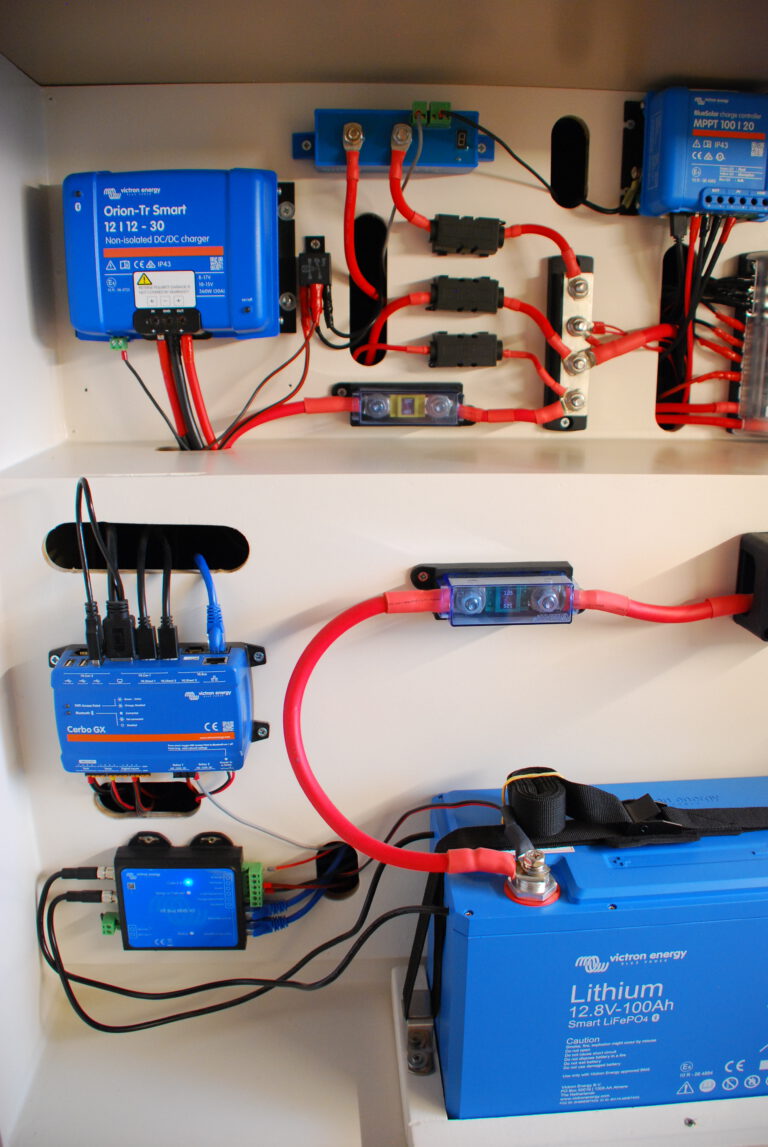
At the center of it all sits the Cerbo GX, running Venus OS Large. Think of it as the nervous system of the van, every component reports back to it, and it’s where all our custom automation lives. Without it, we’d have a collection of smart components. With it, we have one coherent system.
Feeding into that system:
- MultiPlus — our inverter/charger. This is what lets us run real 230V appliances off the battery bank as if we were plugged into shore power, and it charges the battery efficiently whenever we are plugged in.
- BlueSolar MPPT — our solar charge controller, paired with a single 215W crystalline panel, mounted flat on the roof.
- Orion TR Smart — our DC-DC charger, which takes power from the alternator while driving and converts it properly for the battery bank, rather than relying on a basic split-charge relay.
- SmartShunt — the component that actually makes “no guessing” possible. It measures exactly what’s going in and out of the battery, in real time, down to the percentage.
- Battery Protect — the safety net. If the battery ever drops below a safe threshold, it disconnects non-essential loads automatically, protecting the battery from damage.
All of it feeds a single 100Ah 12V Victron LiFePO4 battery, lithium iron phosphate, chosen specifically for its safety profile, cycle life, and consistent voltage under load.
Three Chargers, Working Together
Here’s the part that genuinely changes how it feels to travel: the MPPT, Orion, and MultiPlus don’t operate in isolation, they work together as one charging strategy.
Drive from one beach to the next, or from a wild spot into a campsite, and by the time you arrive, the battery is already full. The Orion has been charging from the alternator the whole drive. The moment the sun’s out, the MPPT is topping things up from the solar panel. And if you ever do plug into shore power, the MultiPlus takes over seamlessly.
In sunny season, this combination is efficient enough that we simply don’t pay for shore power at campsites. One flat 215W panel sounds modest on paper, but paired with smart, prioritized charging instead of a single dumb input, it’s more than enough to keep the system topped up through normal daily use.
The Custom Layer: Node-RED Automation
Victron’s ecosystem is powerful out of the box, but the Cerbo GX also opens the door to something most builders never touch: custom automation through Node-RED.
We used this to solve one of the more important safety requirements in van conversions, ensuring that certain loads only run when the vehicle’s ignition allows it, in line with ECE R10 regulations on electromagnetic compatibility and load management. The most elegant solution we found was an ignition-triggered load disconnect, built around a Hella relay and controlled through Node-RED logic on the Cerbo GX itself.
Rather than bolting on a separate mechanical timer or a simple physical switch, the whole thing lives inside the same system that already monitors and manages every other part of the van’s power. One brain, one source of truth, no extra hardware cluttering the electrical bay. It’s the kind of solution that looks simple from the outside, flip the ignition, the system adjusts, but represents exactly the kind of integration we look for in every part of Meadow’s build: components that don’t just coexist, but actually talk to each other.
Monitoring: Beyond Just Battery Percentage
One of the most underrated parts of the Victron ecosystem is the VRM (Victron Remote Monitoring) portal. It doesn’t just show you battery state of charge, it can track temperature sensors, tank levels, and other metrics from anywhere, on your phone.
That’s a meaningful shift in how you relate to a van. Instead of physically checking a gauge or guessing how much water is left, everything you’d want to know about the van’s systems is in one place, whether you’re standing next to it or hundreds of kilometers away.
Installing It: Intuitive, But Not Casual
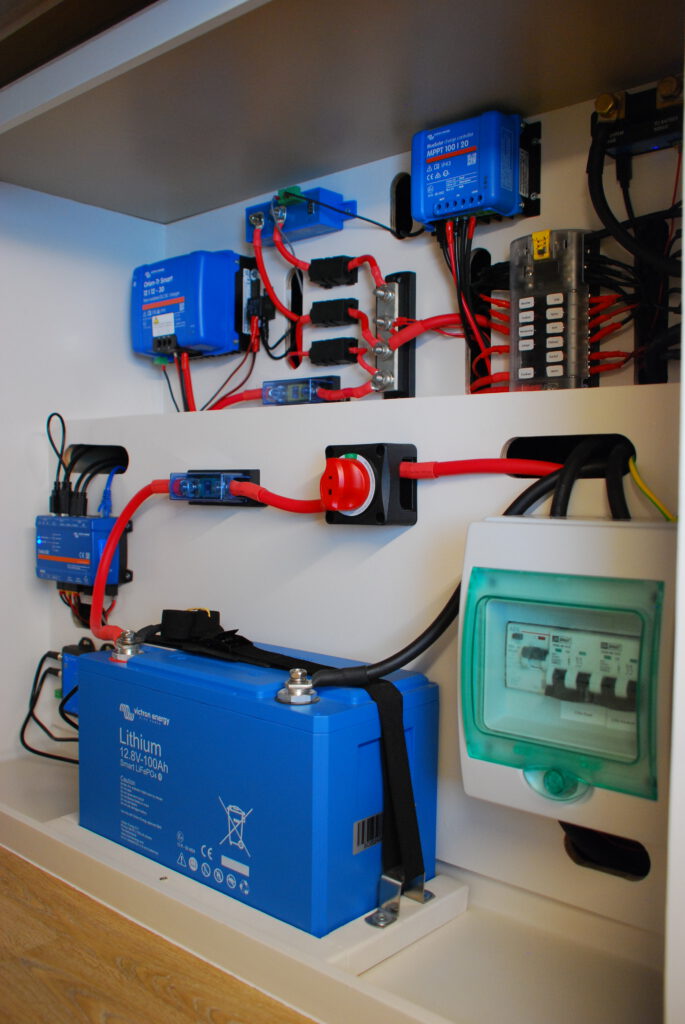
We won’t pretend the installation itself was some kind of engineering challenge, physically, wiring a Victron system is genuinely intuitive, and the documentation is thorough. What it does demand is a serious amount of study beforehand: understanding how each component talks to the others, what the Node-RED logic needs to account for, how to size everything correctly for the battery bank and expected loads.
That’s not a complaint. If anything, it’s the opposite, the sheer amount of detail Victron provides is exactly what lets you install with confidence instead of guesswork. You do the studying once, and the payoff is a system you fully understand and trust for years.
Why This, and Not Something Simpler
There are simpler electrical setups out there: a basic battery, a basic charger, a basic monitor. They work, in the sense that the lights turn on. But we don’t think there’s currently another combination on the market that matches this level of reliability, integration, and flexibility at once. The difference isn’t really about any single component. It’s about how completely they work as one system, and how much that system can be extended, automated, and monitored without adding complexity.
For us, that’s not a luxury. It’s the foundation Meadow is built on.